
Paid Collaboration vs Sponsorship: What Creators Need to Know in 2026
Paid collaborations and sponsorships sound the same — they aren't. Here's the 2026 creator guide to definitions, pricing, usage rights, disclosure and negotiation.
Almost every creator we talk to uses "paid collaboration" and "sponsorship" as if they mean the same thing. In a DM, that's fine. On a contract, in a media kit, or in a negotiation call with a brand manager, those two words mean very different things — and the difference shows up in the deliverables, the pay, the rights, and the disclosure obligations.
This guide is the long, plain-English version: what paid collaborations are, what sponsorships are, how creators get paid in 2026, what to charge, what to never give away for free, and how to negotiate the deal so it actually adds up. It is written for creators, UGC creators, TikTok and Instagram creators, YouTubers, and freelancers who work with brands. If you ever wondered why one creator with the same followers as you can charge five times more, the answer is almost always hiding inside the difference between these two words.
For shorter reference entries, see the glossary on paid collaboration, brand deals, sponsored posts, creator pricing, and usage rights. Then come back here — this article ties everything together.
Why creators confuse paid collaborations and sponsorships
There is a reason these two terms blend together. Platforms use both interchangeably in their own UI. Brands rotate the words depending on what they want to communicate to their finance team versus their PR team. And most creator-economy content treats "brand deal", "collab" and "sponsorship" as synonyms.
The problem only shows up when money does. A "paid collaboration" framed as "just a quick sponsorship" can quietly include perpetual paid-ad usage rights, category exclusivity, and three rounds of revisions for the same flat fee. That isn't a $1,000 post anymore — that is a $4,000 to $8,000 deal, and the creator just gave the difference away because of two words.
Understanding the difference matters for three reasons:
- Pricing. Sponsorships are priced like retainers. Paid collaborations are priced per deliverable. Mixing them up underprices long-term work by 30%–60%.
- Negotiation. Sponsorships have category exclusivity baked in. Paid collaborations usually do not. If you accept "exclusivity" on a single-post fee, you have just blocked yourself from working with competitors for months — for free.
- Risk. Sponsorships almost always require disclosure on every piece of content for the duration of the relationship. Skipping that in even one Story can trigger strikes from platforms and warnings from the FTC.
If you only remember one line from this guide, make it this: every sponsorship is a paid collaboration, but not every paid collaboration is a sponsorship.
What is a paid collaboration?
A paid collaboration is the umbrella term for any deal where a brand compensates a creator — in cash, contracted product value, or a documented fee — in exchange for content, promotion, or audience access. It is the broadest possible definition of paid creator work.
Real-world examples of paid collaborations:
- A nano TikTok creator paid $250 to film one product unboxing video.
- An Instagram micro creator paid $1,500 for one Reel and three Stories.
- A UGC creator delivering five vertical clips for $2,000, licensed for the brand's organic channels.
- A YouTuber paid $4,000 for a 60-second dedicated mid-roll.
- A LinkedIn creator paid $800 for a single sponsored carousel post.
In every case, the structure is the same: there is a specific deliverable, a specific fee, and a defined scope. Once the deliverable is published and approved, the relationship ends — unless the brand books another collab.
Paid collaborations are how most creator–brand work starts. They are easier to sell because they are low-commitment for both sides. The brand tests the creator on one campaign. The creator tests the brand's communication, payment terms, and creative direction without locking themselves into a multi-month relationship. Once both sides trust each other, the conversation often graduates into a sponsorship.
For a tighter definition and example contracts, see the glossary entry on paid collaboration.
What is a sponsorship?
A sponsorship is a specific type of paid collaboration, usually larger, longer, and broader in scope. Where a paid collaboration is about a deliverable, a sponsorship is about a relationship: the brand sponsors a series, a season, a podcast run, a tour, an event, or an ambassador window.
Sponsorships typically include:
- A defined campaign window (a month, a quarter, six months, a year).
- Multiple touchpoints across multiple pieces of content.
- Cross-channel obligations (organic posts plus Stories plus newsletter mentions, for example).
- Tighter exclusivity around the brand's category.
- A recurring fee, retainer, or per-episode rate instead of a one-off invoice.
Real-world examples of sponsorships:
- A podcast accepting $3,000 per episode for a 10-episode host-read campaign.
- A YouTuber accepting $25,000 for a four-video sponsored series across two months.
- An Instagram creator paid $6,000 per month for 12 months as a brand ambassador, with quarterly in-person events.
- A TikTok creator running a six-week "always-on" sponsorship with two videos per week from one brand.
- A LinkedIn creator running a quarterly thought-leadership sponsorship with three carousels and one livestream per quarter.
Sponsorships are how creators stabilise their income. Instead of chasing one-off invoices, the creator has a known monthly or quarterly floor — and brands get sustained share-of-voice with an audience they already trust. For more on long-form deals and how they fit into a creator income mix, see brand deals and sponsored post.
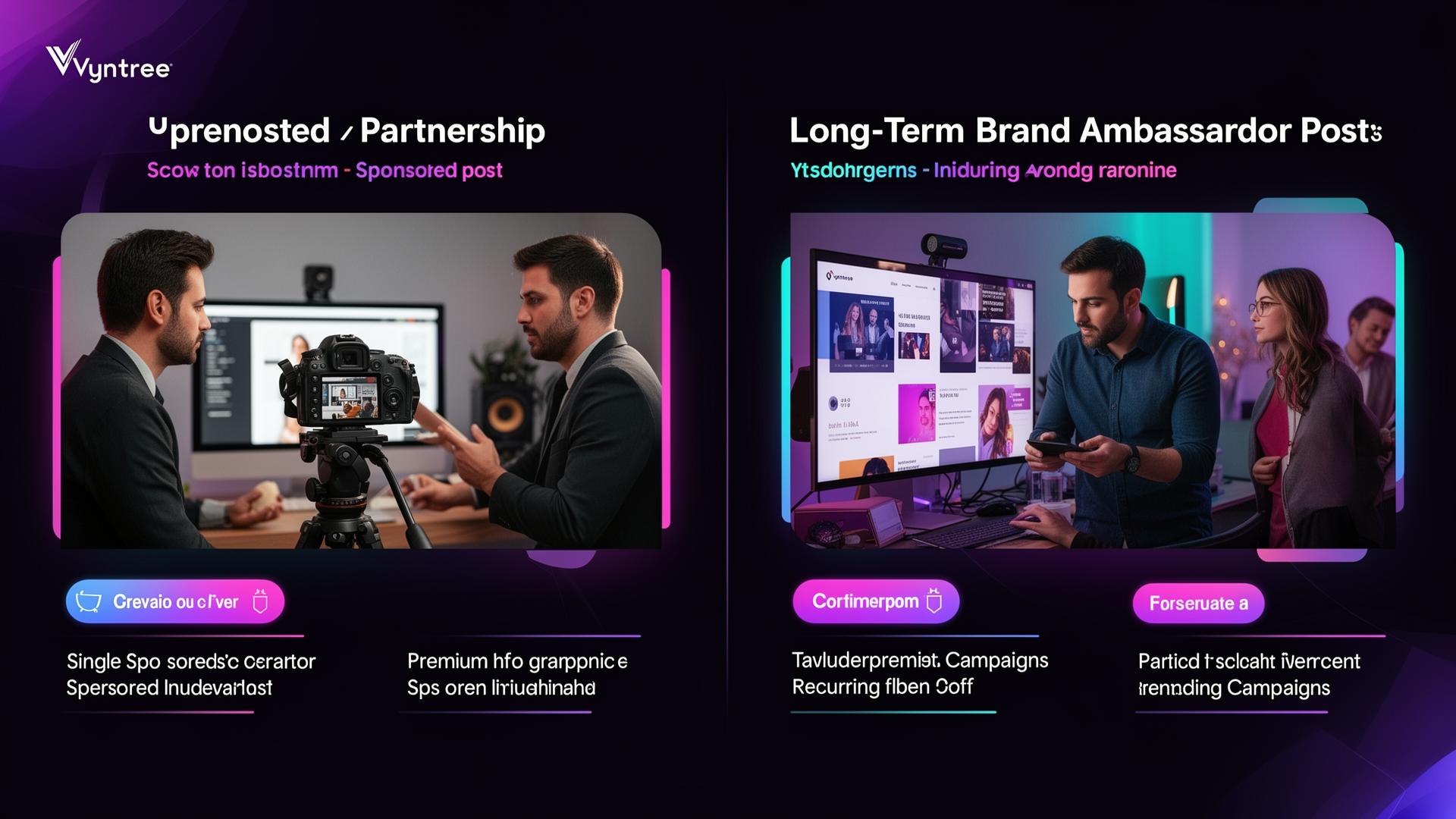
Paid collaboration vs sponsorship: a side-by-side
The clearest way to lock in the difference is a direct comparison. The table below summarises how each term plays out in the real world.
| Dimension | Paid collaboration | Sponsorship |
|---|---|---|
| Payment structure | Per-deliverable fee, paid on completion | Flat retainer, per-episode rate, or monthly fee |
| Deliverables | One or a small package (1–5 posts) | A series, season, event or always-on schedule |
| Duration | Days to a few weeks | Weeks to 12+ months |
| Brand relationship | Transactional, project-based | Strategic, recurring, often co-marketed |
| Usage rights | Negotiated per asset, often organic-only | Frequently includes paid-ad usage and longer windows |
| Creative freedom | High — creator-led content with brand brief | Mixed — brand often shapes narrative across episodes |
| Exclusivity | Usually narrow or none | Common, sometimes category-wide |
| Typical creator size | Open to nano and micro creators | More common from micro creators upward |
| Disclosure | #ad / Paid Partnership per post | "Sponsored by", "Brought to you by", paid-promotion tag every time |
| Where it lives | Reels, TikTok, Stories, single YouTube video, UGC clips | Podcasts, YouTube series, ambassador programs, events, newsletters |
Dimension
Payment structure
Paid collaboration
Per-deliverable fee, paid on completion
Sponsorship
Flat retainer, per-episode rate, or monthly fee
Dimension
Deliverables
Paid collaboration
One or a small package (1–5 posts)
Sponsorship
A series, season, event or always-on schedule
Dimension
Duration
Paid collaboration
Days to a few weeks
Sponsorship
Weeks to 12+ months
Dimension
Brand relationship
Paid collaboration
Transactional, project-based
Sponsorship
Strategic, recurring, often co-marketed
Dimension
Usage rights
Paid collaboration
Negotiated per asset, often organic-only
Sponsorship
Frequently includes paid-ad usage and longer windows
Dimension
Creative freedom
Paid collaboration
High — creator-led content with brand brief
Sponsorship
Mixed — brand often shapes narrative across episodes
Dimension
Exclusivity
Paid collaboration
Usually narrow or none
Sponsorship
Common, sometimes category-wide
Dimension
Typical creator size
Paid collaboration
Open to nano and micro creators
Sponsorship
More common from micro creators upward
Dimension
Disclosure
Paid collaboration
#ad / Paid Partnership per post
Sponsorship
"Sponsored by", "Brought to you by", paid-promotion tag every time
Dimension
Where it lives
Paid collaboration
Reels, TikTok, Stories, single YouTube video, UGC clips
Sponsorship
Podcasts, YouTube series, ambassador programs, events, newsletters
In practice, most creators end up doing a mix of both — paid collaborations to fill gaps and test new brands, and one or two sponsorships running in the background that cover their baseline income.
Real creator examples
The cleanest way to see this is through four examples that mirror the four most common creator profiles working with brands today.
Example 1 — Micro Instagram creator
Maya is a fashion micro-creator with 38,000 followers and a 4.7% engagement rate. A skincare brand offers her a deal: one Reel, three Stories, no usage rights beyond the brand's own organic re-post, two-week turnaround. She charges $1,400.
That is a paid collaboration. Single deliverable package, single fee, one campaign window. When the deal closes, she invoices, the brand pays in 14 days, and she's free to work with a competitor next month.
Example 2 — UGC creator
Jordan is a UGC creator who doesn't post to a personal feed at all. A DTC pet food brand commissions five vertical clips for use as TikTok and Meta ad creative. Fee: $2,800, with 12 months of paid-ad usage included.
That is also a paid collaboration, but priced very differently. The base UGC fee would be $1,200 — the usage rights are doing most of the work. Without them, Jordan would have left $1,600 on the table. UGC deals almost always live or die on usage rights, which is why the usage rights section below matters so much.
Example 3 — Large Instagram + TikTok influencer
Sofia has 480,000 followers across Instagram and TikTok. A nutrition brand wants her as a "face" of the brand for 6 months — two posts per month, one ambassador event per quarter, exclusivity within sports nutrition, and full paid-ad whitelisting for the duration. The fee is $9,000 per month.
That is a sponsorship. It is a recurring retainer, multi-channel, with exclusivity and paid-media rights, lasting half a year. The contract reads like a freelance employment agreement, not a single-invoice deal.
Example 4 — YouTube creator
Daniel runs a tech-review YouTube channel with 220,000 subscribers. A keyboard brand books eight integrated mid-rolls across four months for a total of $32,000, each ~75 seconds, with first-look exclusivity on competing keyboards during the window.
That is a sponsorship. Multi-video, multi-month, category exclusivity, recurring deliverables. The brand isn't paying for one video — it's paying to be the keyboard sponsor of Daniel's channel for one season.
How much should creators charge?
There is no single right number, but there is a framework. Pricing should always come from five inputs, in this order: follower count, engagement, niche, deliverables, and usage rights.
1. Follower count
A useful 2026 starting heuristic: roughly 1% of follower count per Reel, TikTok, or short-form video as a base rate, before adjusting for everything else. A 50,000-follower creator starts the conversation at $500 per short-form video. A 250,000-follower creator starts at $2,500. From there, every other lever pushes the number up or down.
| Audience size | Per-deliverable paid collab | Monthly sponsorship retainer |
|---|---|---|
| Nano (1K–10K) | $50–$500 | $500–$2,500 |
| Micro (10K–100K) | $500–$5,000 | $2,500–$15,000 |
| Mid-tier (100K–500K) | $2,500–$15,000 | $10,000–$50,000 |
| Macro (500K–1M) | $10,000–$50,000+ | $50,000–$150,000+ |
| Mega (1M+) | $25,000–$250,000+ | Custom |
Audience size
Nano (1K–10K)
Per-deliverable paid collab
$50–$500
Monthly sponsorship retainer
$500–$2,500
Audience size
Micro (10K–100K)
Per-deliverable paid collab
$500–$5,000
Monthly sponsorship retainer
$2,500–$15,000
Audience size
Mid-tier (100K–500K)
Per-deliverable paid collab
$2,500–$15,000
Monthly sponsorship retainer
$10,000–$50,000
Audience size
Macro (500K–1M)
Per-deliverable paid collab
$10,000–$50,000+
Monthly sponsorship retainer
$50,000–$150,000+
Audience size
Mega (1M+)
Per-deliverable paid collab
$25,000–$250,000+
Monthly sponsorship retainer
Custom
These ranges blur heavily by platform — TikTok rates tend to run 20%–30% lower than Instagram Reels for similar reach, while YouTube long-form integrations often run 3–5× higher per deliverable because of the duration and search half-life.
2. Engagement
Engagement multiplies (or divides) the base number. A 30K-follower creator with a 7% engagement rate is, for most brand briefs, more valuable than a 100K-follower creator with a 1.2% engagement rate. Healthy benchmarks in 2026 sit around 3%–6% on Instagram and 4%–8% on TikTok, with everything below 1% raising questions about bot followers or unengaged audiences. For benchmarks, see the Engagement Rate Benchmarks 2026 report and the glossary entry on engagement rate.
3. Niche
Niche is the silent multiplier. Finance, B2B, parenting, beauty, fitness, fashion and home all carry premium CPMs because the brands in those niches make high-LTV sales. Gaming, lifestyle, comedy and general entertainment tend to price lower per follower because brand budgets are spread thinner. A 50K-follower finance creator may charge 2–4× what a 50K-follower entertainment creator charges for the exact same deliverable.
4. Deliverables
The deliverable shapes the number more than most creators realise. A Reel is more expensive than a Story. A YouTube long-form integration is more expensive than a YouTube Short. A multi-frame carousel is more expensive than a single image. Bundled packages — "one Reel + three Stories + one carousel" — should price at roughly 1.6–2.5× the cost of the headline asset, not the sum of every line item.
5. Usage rights
This is the lever creators leave money on most often. We'll dedicate the next section to it.
For a calculator that bundles all five inputs into a defendable number, use the free Creator Rate Calculator. For deeper, niche-by-niche benchmarks, see the Creator Pricing Report 2026, creator pricing, and rate card.
Usage rights explained
Usage rights define how and where the brand is allowed to reuse your content. They are not a footnote on the contract — they are often the largest single dollar value inside the deal. Most under-priced creator contracts are under-priced not on the base fee but on usage rights.
There are four common tiers:
- Organic usage. The brand reposts your content on its own organic channels — feed, Stories, website. This is the baseline; usually included in the base rate.
- Paid ads (whitelisting / spark ads). The brand runs your content as a paid ad, either from its own ad account ("dark posts") or under your handle ("whitelisting"). This typically adds 30%–50% for a 30-day window, 60%–100% for a 90-day window, and more for longer.
- Whitelisting under your handle. A specific subset of paid-ad usage where the ad appears to come from you, not the brand. Higher trust = higher conversion = higher fee. See whitelisting for the full mechanic.
- Perpetual usage / full buyout. The brand can use the content forever, across any channel, with no time limit. This is the most expensive option — never agree to a perpetual buyout without at least a 2–3× multiplier on the base fee, and ideally a category exclusivity carve-out too.
A practical 2026 framework:
- Organic only: base rate, e.g. $1,000.
- + paid-ad usage, 30 days: +30%–40%, e.g. $1,350.
- + paid-ad usage, 6 months: +60%–100%, e.g. $1,800.
- + perpetual usage: 2–3× base, e.g. $2,500–$3,000.
The single best habit a creator can build is to always ask whether the brand wants paid-ad usage before quoting. If the answer is yes, your number changes. If the answer is "we'll figure it out later", the answer is also yes — quote like it is.
Disclosure rules
Both paid collaborations and sponsorships require clear, conspicuous disclosure. This is not optional, and the rules have tightened every year since 2022.
The principle, across the FTC (US), ASA (UK), AGCM (Italy), and most EU national regulators, is the same: a reasonable viewer should be able to tell, immediately and without scrolling, that the content is paid.
In practice, that means using both layers:
- The platform's native tag. Instagram's "Paid Partnership" tag, YouTube's "Includes paid promotion" toggle, TikTok's branded-content toggle, LinkedIn's paid-partnership label. These tags also unlock the brand's ability to boost your content as an ad.
- An in-caption / on-screen tag. #ad, #sponsored, or "Paid partnership with [Brand]" in the first line of the caption — not buried under "...more". On video, the same disclosure should appear on screen within the first three seconds and be said out loud in the first 30 seconds for podcasts or longer video.
Specific rules that creators consistently get wrong:
- "Gifted" or "PR" still needs disclosure if there was any expectation of posting. #gifted is fine; silence is not.
- "Ambassador" relationships need disclosure on every post for the entire ambassador window, not only the first one.
- Affiliate links require disclosure too. #ad or #affiliate works.
- Disclosure must be in the same language as the audience. A Dutch-speaking audience needs the disclosure in Dutch.
The penalty for skipping disclosure is rarely a fine for the individual creator — it is account-level strikes, paid-ad ineligibility on the campaign, and reputational damage with the brand. The fine, when it does land, usually lands on the brand. The strike lands on the creator.
When should you choose a paid collaboration?
Paid collaborations are the right structure when:
- You are working with a brand for the first time and want to keep optionality.
- The campaign is one launch, one product, or one campaign moment.
- The brand only needs a single deliverable or a tight package.
- You want to keep your category open for other brands.
- You are testing a niche, a creative angle or a content format you're not yet sure converts.
- You're a smaller creator and the brand isn't ready to commit to a retainer yet.
If any of those apply, price per deliverable, scope tightly, cap usage rights at organic, and leave the door open to graduate the relationship into a sponsorship later.
When should you choose a sponsorship?
Sponsorships are the right structure when:
- The brand has clear, recurring need over a defined window (a season, a product cycle, a year).
- You want stable monthly income to plan your business around.
- The brand wants exclusivity in your category — and is willing to pay for it.
- You want to deepen the creative work beyond a one-off post (longer-form integrations, custom content, live events).
- The campaign requires multi-channel deliverables that wouldn't make sense to invoice separately every two weeks.
Sponsorships are also the natural next step after two or three successful paid collaborations with the same brand. By that point both sides know the working rhythm, the brand has data on what your content converts, and the upgrade conversation gets easy.

How brands evaluate creators
Brands look at four things, in roughly this order, when deciding whether to book a creator for either a paid collaboration or a sponsorship:
- Engagement quality. Engagement rate, comment quality, save and share rates — not just likes. Most brands now treat anything below 1% as a red flag for inflated followers. The engagement rate benchmarks 2026 report is the cleanest reference; for definitions, see engagement rate.
- Audience fit. Geo, age, language, interests. A creator with 200K followers in the wrong country for the brand is worth less than a creator with 20K in the right one.
- Content quality. Production value, on-brand aesthetic, ability to integrate a product naturally without breaking the creator's voice. Brands increasingly want creators who can produce content that doubles as paid-ad creative.
- Trust signals. A clean media kit, a professional rate card, past brand work, written contracts, on-time delivery, professional comms. Brands talk to each other. A reputation for being easy to work with raises your effective rate by 20%–40% over time.
A polished creator hub helps with all four. A single page with stats, niche, audience demographics, past work, and a brand-inquiries form makes you discoverable and bookable — which is exactly what a Vyntree creator hub is built for.
Common mistakes creators make
Across thousands of creator-brand deals, the same handful of mistakes show up again and again. Most of them are not pricing mistakes — they're scoping mistakes that turn into pricing mistakes.
- Charging too little. Quoting from gut instead of from a formula. Use the 1%-of-followers heuristic as a floor and adjust from there.
- Not discussing usage rights. Letting the brand reuse content as paid ads "as part of the deal" because nobody asked. That's the single biggest leak.
- Unclear deliverables. "A few Stories" turns into nine Stories, two reposts, a Reel, and a co-branded carousel. Specify counts, format, hashtags, mandatory CTA, and approval rounds.
- No written agreement. Even on a $300 deal, send a one-page SOW. Email confirmation counts, but a signed SOW is what holds up when payment is late.
- Accepting open-ended exclusivity. "We'd just love it if you didn't post anything competitive for a while" is a 6-month category lockout dressed as a friendly request.
- Forgetting kill fees. If a campaign gets cancelled after you've shot the content, you should still be paid 50%–100% depending on how far along you were.
- Treating sponsorships like single posts. Pricing a 12-month ambassador deal as "twelve Reels times my Reel rate" undervalues it by 30%–50%. Sponsorships are retainers; price them as retainers.
- No invoicing system. Net-30 becomes net-90 fast when invoices are inconsistent. Use the same template every time and follow up on day 31.
The brand isn't paying for your post. They're paying for your audience's attention, your creative skill, and the rights to reuse the content. Price every clause separately, then bundle.
Negotiation playbook
A short, repeatable script that works for almost every paid collaboration or sponsorship conversation:
- Ask for the brief in writing. Goals, deliverables, dates, channels, usage, exclusivity. Anything verbal turns into scope creep.
- Ask whether the brand wants paid-ad usage. Before quoting. Always.
- Quote a range, not a single number. "$1,800 to $2,400 depending on usage and exclusivity" gives the brand room to pull you up, not down.
- Anchor on a package. Packages should be 1.6–2.5× the headline asset, not a flat-sum of every line item.
- Charge for revisions outside scope. Two rounds included, every round after at 25% of the base rate.
- Build in a kill fee. Standard: 50% if cancelled within 14 days of delivery, 100% after content is shot.
- Specify payment terms. Net-30 is standard. Net-15 for smaller creators and new brands. Late-payment interest at 1.5% per month is reasonable.
- Get it signed. A short SOW with deliverables, fees, dates, usage, exclusivity, kill fee and disclosure obligations is enough — five clauses on one page.
For the full pricing-and-monetization playbook that sits underneath all of this, see Creator Monetization.
Tying it back to your creator hub
Paid collaborations and sponsorships only work if brands can actually find you, book you, and trust you. The two highest-leverage things a creator can do this year are very simple:
1. Calculate and publish a defendable rate using the Creator Rate Calculator — backed by audience size, engagement, niche, deliverables and usage. 2. Run a single creator hub that hosts your stats, your media kit, your past brand work, your audience demographics, and a brand-inquiries form. That hub is the URL you put in every email, every DM bio, every pitch.
Brands don't want to chase you across five platforms. A single hub is the difference between a brand booking the creator they found in five seconds and the creator they couldn't.
Frequently asked questions
What does paid collaboration mean? A paid collaboration is any deal where a brand pays a creator — in cash, fee, or contracted compensation — in exchange for content, promotion or audience access. It is the umbrella term that covers sponsored posts, UGC deliverables, brand partnerships, ambassador work and sponsorships.
Is a paid collaboration a sponsorship? Not always. Every sponsorship is a paid collaboration, but not every paid collaboration is a sponsorship. Sponsorships are usually larger, longer (weeks to months), and cover a series, season or program — a one-off paid post for a single product is a paid collaboration but not a sponsorship.
How much should creators charge? A common 2026 benchmark is roughly 1% of follower count per Reel or TikTok as a starting point, then adjust for engagement, niche, deliverables and usage rights. Nano-creators charge $50–$500 per deliverable, micro-creators charge $500–$5,000, mid-tier creators charge $2,500–$15,000. Use the [Creator Rate Calculator](/tools/creator-rate-calculator) for a tailored number.
What are usage rights? Usage rights define how a brand is allowed to reuse your content. Organic usage on the brand's channels is the baseline. Paid-ad usage (boosting, whitelisting, spark ads) and perpetual / buyout rights are worth significantly more — usually 30%–200% on top of the base rate.
Do creators need to disclose sponsorships? Yes. The FTC (US), ASA (UK) and EU consumer regulators all require clear, conspicuous disclosure for any paid relationship. Use the platform's native tag and an in-caption #ad in the first line — not buried at the end.
What is whitelisting? Whitelisting is when a creator grants a brand permission to run paid ads from the creator's own account handle. The brand keeps targeting, budget and analytics control while the content appears to come from the creator. It costs more than organic-only usage because the brand gets long-running paid-media value from your handle.
Can small creators get sponsorships? Yes. Brands increasingly partner with nano and micro creators because engaged niche audiences convert better than broad reach. Most small creators start with one-off paid collaborations and grow into recurring sponsorships once trust and performance are proven.
Conclusion
Paid collaboration is the umbrella. Sponsorship is the long, recurring version of it. Both require disclosure. Both have a base fee, plus usage rights, plus exclusivity, plus deliverable scope — and the difference between a fair deal and an under-priced one almost always lives inside those last three clauses.
The creators who win in 2026 are not the ones with the biggest followings. They are the ones who price clearly, scope tightly, ask about paid-ad usage every single time, get it in writing, and run their brand-inquiry flow from a single, professional hub.
Know what your content is worth
You don't need to guess. Two free tools cover almost everything in this guide:
- Calculate Your Creator Rate — get a defendable number based on followers, engagement, niche, deliverables and usage rights.
- Build Your Creator Hub With Vyntree — one URL for your stats, media kit, past brand work, and brand-inquiries form.
For the deeper monetization playbook, read Creator Monetization. Then come back to this guide every time a brand emails you — and price the deal you actually deserve.